

What Smart City Technology Actually Means (And Why Most Organizations Get Integration Wrong)
Cloud Services | Government | Managed IT | Office Copiers, Printers, and MFPs | Office Technology | Pro AV
The phrase “smart city” gets used a lot. It shows up in government planning documents, technology vendor pitches, and conference keynotes. But for the administrators, IT directors, and operations managers actually responsible for making organizations run, the concept often feels abstract.
What does smart city technology actually mean in practice? And more importantly, what does it take to implement it in a way that delivers real operational improvement rather than just adding more systems to manage?
What Does “Smart City Technology” Actually Mean?

Strip away the buzzwords and smart city technology comes down to a straightforward idea: using connected digital systems to help organizations operate more efficiently, serve people more effectively, and respond faster when conditions change.
That sounds simple. The complexity is in the execution.
Most organizations already have pieces of this in place. They have printers, some form of document storage, an IT infrastructure, maybe a cloud platform or two. The gap isn’t usually in having zero technology. It’s that the technology they have wasn’t designed to work together, wasn’t implemented with integration in mind, and has grown over time through a series of disconnected purchasing decisions.
The result is familiar to anyone who has worked in a mid-size or large organization: systems that don’t talk to each other, manual handoffs where automation should exist, IT teams spending most of their time putting out fires rather than building toward anything, and compliance obligations that are difficult to demonstrate because the audit trail is scattered across five different platforms.
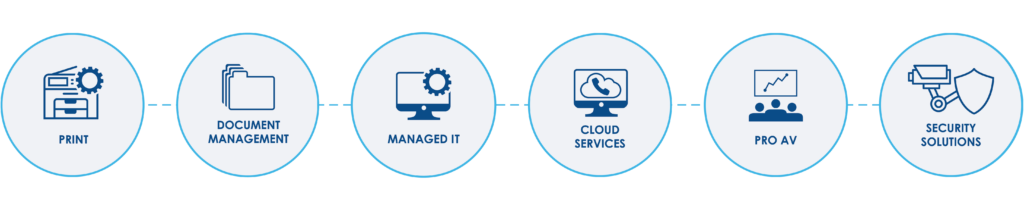
The Six Disciplines That Make Up a Connected Technology Environment
A useful way to think about organizational technology is through six disciplines that together cover the full lifecycle of how information and people move through an environment. Each discipline plays a distinct role, from creating and managing documents to supporting communication, security, infrastructure, and collaboration. When these areas work together, technology becomes less fragmented and more connected to the way people actually work.
1. Print: Smart Print for Smarter Cities
Print still plays an important role in public sector operations. Permits, forms, notices, signage, training materials, reports, and resident-facing communications all depend on reliable print infrastructure.
In a connected environment, print is not treated as a standalone utility. Multifunction devices are secured, monitored, and managed as part of the broader technology ecosystem. That means better control over sensitive information, more efficient supply and service management, and fewer disruptions for teams that depend on printed materials to keep work moving.
Smart print helps public teams support essential services while maintaining the security, accountability, and reliability modern operations require.
2. Document Management: Workflows That Move Faster
Many city and public sector processes still depend on documents moving between people, departments, and approval paths. When that movement relies too heavily on paper, email attachments, or manual handoffs, work slows down.
Document management helps turn paper-heavy processes into secure digital workflows. Applications can be routed automatically. Records can be stored in searchable repositories. Access can be controlled by role. Retention policies can be applied consistently. Approval history can be tracked more clearly.
For smart city environments, document management is not just about reducing paper. It is about helping information move faster, with fewer bottlenecks and better visibility.
3. Managed IT: The Backbone of a Smarter City
Every connected system depends on the strength of the IT environment behind it. Networks, endpoints, servers, users, applications, and security policies all need to be managed proactively.
Managed IT helps organizations move from reactive troubleshooting to ongoing monitoring, maintenance, patching, support, and planning. This is especially important in environments where technology supports public-facing services, distributed teams, and shared spaces.
When IT is stable and well-managed, other systems can work more effectively. Print environments can be monitored. Cloud platforms can be governed. Security systems can stay connected. Pro AV tools can operate on reliable networks.
Managed IT is the backbone that helps the rest of the smart city environment stay secure, connected, and operational.
4. Cloud Services: Access That Keeps Up
Public sector teams are often spread across departments, buildings, and locations. They need secure access to communication tools, files, applications, and collaboration platforms wherever work happens.
Cloud services help support that flexibility. They can improve communication, strengthen business continuity, support remote and hybrid work, and make information easier to access across teams.
The key is governance. Cloud platforms need to be designed with access control, security, identity management, and integration in mind. When cloud services are connected to the broader technology environment, teams can work more efficiently without creating new silos.
5. Pro AV: Public Spaces That Communicate
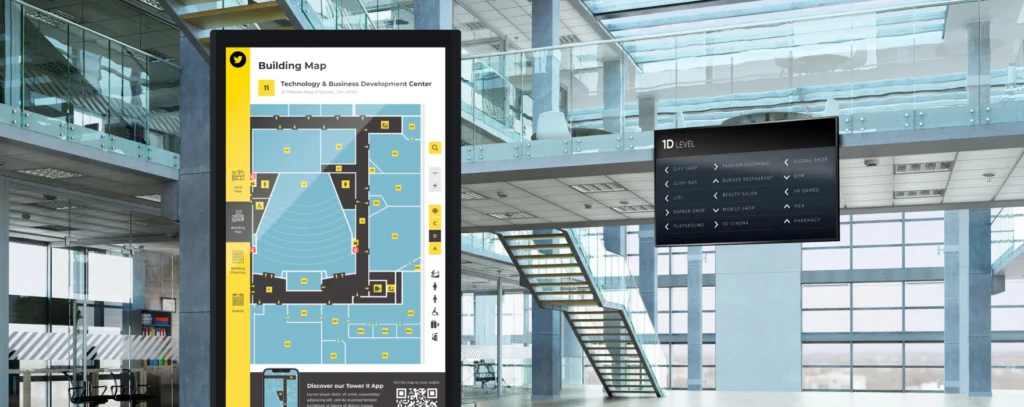
Smart cities depend on clear communication in physical spaces. That communication may happen in council chambers, meeting rooms, public venues, transit areas, municipal buildings, training spaces, or community environments.
Pro AV solutions help organizations share information where people need it most. Digital signage can display schedules, alerts, maps, announcements, and wayfinding. Meeting room systems can support hybrid collaboration. Displays and audio systems can improve visibility and participation in public-facing spaces.
In a connected environment, Pro AV is not just equipment in a room. It is part of the larger communication strategy, helping public spaces become more informative, accessible, and responsive.
6. Security Solutions: Security That Connects the Dots
Physical security is now closely tied to the broader technology environment. Cameras, access control, visitor management, alerts, and monitoring platforms all generate information that can help organizations understand what is happening across their spaces.
When these systems operate separately, visibility is limited. When they are connected, teams can monitor activity more effectively, respond faster, and coordinate security decisions with greater context.
Security solutions help organizations connect the dots between people, places, systems, and events. In a smart city environment, that connected visibility is essential for protecting public spaces, supporting operational awareness, and helping teams act with confidence.
Why Integration Is Harder Than It Looks
Each of these disciplines has its own vendor ecosystem, its own technical standards, and its own organizational stakeholders. In most organizations, print is managed by facilities or operations, IT infrastructure by the IT department, cloud services sometimes by IT and sometimes by individual business units, and physical security often by a completely separate team.
This isn’t a failure of management. It’s a natural consequence of how organizations grow and how technology gets adopted incrementally over time.
The problem is that a technology environment built from disconnected decisions has predictable failure modes. Security policies don’t extend to print infrastructure. Document workflows don’t connect to identity management systems. Physical access events don’t feed into IT security monitoring. Cloud platforms operate under different governance rules than on-premise systems.
Each gap is manageable on its own. Collectively, they represent meaningful operational risk and significant compliance exposure.
True integration requires thinking about these six disciplines as a single environment from the start, or rearchitecting an existing environment with that goal in mind. It requires a technology partner with competency across all six areas, not a collection of specialized vendors who each optimize for their own domain.
What a Well-Integrated Environment Actually Looks Like
In practice, integration shows up in specific, concrete ways.
Authentication policies that govern network access also govern print release, so a departing employee’s access is revoked across all systems simultaneously. Document workflows connect to cloud storage and identity management, so the right people can access the right records from any location without manual permission management. Physical access events feed into security monitoring dashboards alongside network and endpoint data. Meeting room systems update in real time based on calendar data living in cloud platforms.
None of these integrations are technically exotic. What makes them uncommon is that achieving them requires coordination across disciplines that organizations typically manage separately.
Frequently Asked Questions
Is smart city technology only relevant for government and municipalities?
- The term originated in urban planning and public sector technology, but the underlying concept applies broadly. Any organization managing distributed operations, physical spaces, and large volumes of information faces the same integration challenges. Healthcare systems, educational institutions, corporate campuses, and professional services firms all operate in environments where the same six disciplines apply.
How do organizations typically start the process of building a more integrated technology environment?
- Most start with an assessment of their current environment across all six disciplines. The goal isn’t to identify everything that’s wrong. It’s to understand where the gaps between systems are creating the most operational friction or compliance risk. From there, integration work is typically phased based on priority rather than attempted all at once.
What’s the difference between having all six technologies and having them integrated?
- Having all six technologies means each system is in place. Integration means they share data, enforce consistent policies, and allow a change in one system to propagate appropriately to others. An organization can have best-in-class products across all six disciplines and still operate in silos if those products were never designed or configured to work together.
How does physical security fit into an IT and cloud technology strategy?
- Physical security systems generate significant amounts of operational data: who accessed which areas, when, and under what circumstances. In an integrated environment, that data connects to identity management and security monitoring systems, giving IT and security teams a more complete picture of activity across both physical and digital environments. Organizations that manage physical security in isolation miss this context entirely.
What makes managing these six disciplines together more effective than managing them separately?
- Consistency, primarily. Separate management means separate policies, separate audit trails, separate vendor relationships, and separate points of failure. Unified management means a change in access policy propagates everywhere it needs to, compliance evidence is consolidated, and the team responsible for technology has visibility across the full environment rather than just their assigned domain.
The Bottom Line
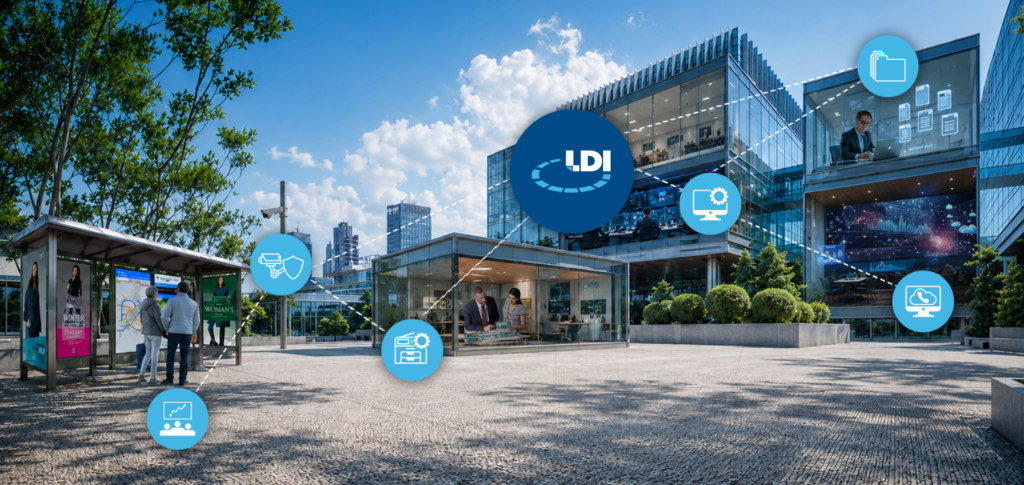
Smart city technology is not one product, one platform, or one department’s responsibility. It is a connected approach to how information, people, spaces, and systems work together.
Print keeps essential communications moving. Document management helps information flow faster. Managed IT supports the infrastructure behind every connected system. Pro AV helps public spaces communicate. Cloud services give teams secure access across locations. Security solutions connect the dots between visibility, awareness, and response.
The organizations that get the most value from smart city technology are not simply adding more tools. They are building environments where those tools work together.
LDI Connect works with organizations across New York, New Jersey, Connecticut, Los Angeles, and Florida across all six disciplines. If you are evaluating where integration gaps may exist in your current environment, an assessment is a good place to start.